 https://doi.org/10.4081/peasa.89
Projects for Europe: the projectification of society as a capacity for progress, renewal and engagement
All claims expressed in this article are solely those of the authors and do not necessarily represent those of their affiliated organizations, or those of the publisher, the editors and the reviewers. Any product that may be evaluated in this article or claim that may be made by its manufacturer is not guaranteed or endorsed by the publisher.
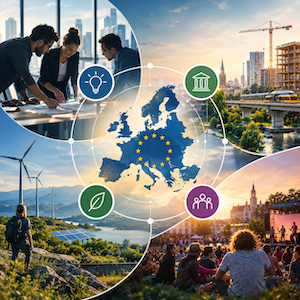
Europe is confronted with technological, economic, environmental, geopolitical and societal challenges that demand more than policy intentions and established organisational routines. They demand the capacity to turn ideas into action and ambitions into tangible change. Projects have become one of the principal organisational forms through which such change is realised. This Academic Engagement/Perspective paper reflects on projectification from a European perspective and distinguishes three interrelated arenas: the private economy, where projects enable innovation, transformation and competitiveness; the public sector, where projects translate policies into infrastructure, reforms and public value; and society at large, where projects provide vehicles for civic engagement, arts, culture and collective action. Projectification is understood here as the increasing prevalence and societal embeddedness of projects and project practices. We distinguish it from project capability, meaning the ability to select, govern, resource, deliver and learn from projects. Evidence from Germany, Norway, Iceland, Croatia and Italy shows that projectification is substantial but not uniform. Our five-country research based on institutional logics further indicates markedly different trajectories even within Europe: Germany is characterised predominantly by a decentralised market- and profession-oriented logic, whereas Croatia displays a stronger supranational European Union governance logic. We therefore argue that projectification should be understood as a contextually embedded societal transformation rather than as a universal model. Europe does not simply need more projects; it needs project capabilities suited to different institutional settings and able to connect temporary initiatives with longer-term organisational and societal purposes.




How to Cite

This work is licensed under a Creative Commons Attribution-NonCommercial 4.0 International License.
Copyright (c) 2026 The Author(s)
PAGEPress has chosen to apply the Creative Commons Attribution NonCommercial 4.0 International License (CC BY-NC 4.0) to all manuscripts to be published.