
 https://doi.org/10.4081/peasa.85
Homo Resonans: sound, resonance, and the emergence of sacred consciousness
HTML: 0
All claims expressed in this article are solely those of the authors and do not necessarily represent those of their affiliated organizations, or those of the publisher, the editors and the reviewers. Any product that may be evaluated in this article or claim that may be made by its manufacturer is not guaranteed or endorsed by the publisher.
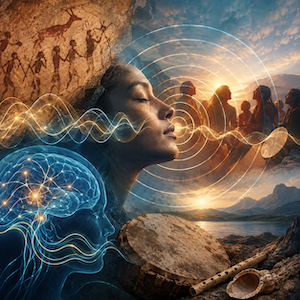
This paper examines the roles of sound, resonance, and rhythmic attunement in the emergence of consciousness and proposes a reconsideration of the human being as Homo Resonans: a fundamentally relational organism whose awareness unfolds through embodied participation in acoustic worlds. Drawing on phenomenology, anthropology, archaeology, sound studies, neuroscience, affect theory, and religious studies, the study argues that sound precedes symbolic language both evolutionarily and developmentally, serving as a primary medium through which perception, memory, sociality, ritual practice, and sacred experience are formed. Through a synthesis of hermeneutic interpretation, phenomenological analysis, and interdisciplinary scholarship, the paper explores how rhythm, vibration, repetition, and listening shape consciousness before conceptual abstraction. Particular attention is given to prehistoric ritual acoustics, proto-musical communication, oral consciousness, sacred vocality, acoustemology, and contemporary research on neural oscillations and rhythmic synchronization. Resonance is examined not merely as an acoustic phenomenon or metaphor but as a constitutive relational structure linking body, environment, memory, affect, culture, and consciousness. Ritual sound practices, collective vocalization, and rhythmic entrainment suggest that awareness emerges through participatory attunement rather than detached cognition alone, while contemporary neuroscience reinforces this view through evidence of oscillatory coordination across neural and bodily systems. The paper advances Homo Resonans as a philosophical anthropology grounded in resonance, embodiment, and relational becoming. Within this framework, sound is understood not merely as an object of perception but as a fundamental condition through which consciousness emerges, meaning is constituted, and the sacred is encountered.




How to Cite

This work is licensed under a Creative Commons Attribution-NonCommercial 4.0 International License.
Copyright (c) 2026 The Author(s)
PAGEPress has chosen to apply the Creative Commons Attribution NonCommercial 4.0 International License (CC BY-NC 4.0) to all manuscripts to be published.