
Truth-ε and machine knowledge: from demonstrative rationality to bounded computational convergence
Published: July 24, 2026
Abstract Views: 17
PDF: 1
Publisher's note
All claims expressed in this article are solely those of the authors and do not necessarily represent those of their affiliated organizations, or those of the publisher, the editors and the reviewers. Any product that may be evaluated in this article or claim that may be made by its manufacturer is not guaranteed or endorsed by the publisher.

Authors

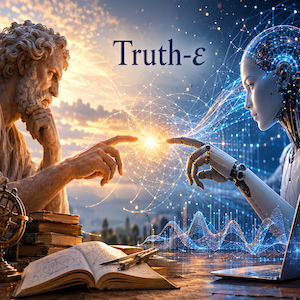
This paper introduces the concept of Truth-ε as a framework for understanding the epistemological status of contemporary artificial intelligence. Modern AI systems increasingly produce reliable and scientifically useful outputs while remaining only partially reconstructible through explicit symbolic reasoning. This raises a central question: how can machine-generated representations count as knowledge if they are neither exact copies of reality nor demonstrative conclusions derived from transparent logical chains? Truth-ε refers to a form of epistemic reliability achieved through convergence under conditions of finite information, uncertainty, and computational limitation. The paper argues that AI does not abolish rationality or reduce truth to mere prediction. Instead, it makes explicit a conception of rationality already embedded in the history of mathematics and science, where knowledge advances through controlled approximation, convergence, and bounded error. From the method of exhaustion and ε–δ analysis to probability theory, information theory, computational complexity, and machine learning, scientific knowledge has evolved by disciplining error rather than eliminating it entirely. Within this framework, AI systems derive epistemic legitimacy through robustness, calibration, generalization, reproducibility, and explicit disclosure of epistemic limits.


Dimensions

Altmetric

PlumX Metrics

Downloads

Downloads

Download data is not yet available.

Citations

Aristotle (1984). Posterior Analytics. In: Barnes J (ed.), The complete works of Aristotle. Princeton: Princeton University Press.
Barredo Arrieta A, Díaz-Rodríguez N, Del Ser J, et al. (2020). Explainable artificial intelligence (XAI): concepts, taxonomies, opportunities and challenges toward responsible AI. Inf Fusion 58:82-115. DOI: https://doi.org/10.1016/j.inffus.2019.12.012
Bender EM, Gebru T, McMillan-Major A, Shmitchell S (2021). On the dangers of stochastic parrots: can language models be too big? In: Proceedings of the 2021 ACM Conference on Fairness, Accountability, and Transparency. New York: ACM. p. 610-23. DOI: https://doi.org/10.1145/3442188.3445922
Bishop CM (2006). Pattern recognition and machine learning. New York: Springer.
Bousquet O, Elisseeff A (2002). Stability and generalization. J Mach Learn Res 2:499-526.
Boyer CB (1959). The history of the calculus and its conceptual development. New York: Dover.
Burrell J (2016). How the machine “thinks”: understanding opacity in machine learning algorithms. Big Data Soc 3:1-12. DOI: https://doi.org/10.1177/2053951715622512
Cantor G (1874). Über eine Eigenschaft des Inbegriffes aller reellen algebraischen Zahlen. J Reine Angew Math 77:258-62. DOI: https://doi.org/10.1515/crll.1874.77.258
Cantor G (1915). Contributions to the founding of the theory of transfinite numbers. Translated by Jourdain PEB. Chicago: Open Court.
Cauchy AL (1821). Cours d’analyse de l’École Royale Polytechnique. Paris: Debure.
Cover TM, Thomas JA (2006). Elements of information theory. 2nd ed. Hoboken, NJ: Wiley.
Dedekind R (1872). Stetigkeit und irrationale Zahlen. Braunschweig: Vieweg.
Doshi-Velez F, Kim B (2017). Towards a rigorous science of interpretable machine learning. arXiv:1702.08608.
Euclid (1956). The thirteen books of Euclid’s Elements. Translated by Heath TL. 2nd ed. New York: Dover.
Floridi L (2011). The philosophy of information. Oxford: Oxford University Press. DOI: https://doi.org/10.1002/9781444396836.ch10
Fokas AS (2023). Can artificial intelligence reach human thought? PNAS Nexus 2:pgad409. DOI: https://doi.org/10.1093/pnasnexus/pgad409
Fokas A (2024). Ways of comprehending: the grand illusion and the essence of being human. New Jersey: World Scientific. DOI: https://doi.org/10.1142/q0447
Fokas A (2026). The embodied mind: unravelling AI, medicine, and physics. New Jersey: World Scientific. DOI: https://doi.org/10.1142/q0540
Goldman AI (1979). What is justified belief? In: Pappas GS (ed.), Justification and knowledge. Dordrecht: Reidel. p. 1-23. DOI: https://doi.org/10.1007/978-94-009-9493-5_1
Goodfellow I, Bengio Y, Courville A (2016). Deep learning. Cambridge, MA: MIT Press.
Gödel K (1931). Über formal unentscheidbare Sätze der Principia Mathematica und verwandter Systeme I. Monatsh Math Phys 38:173-98. DOI: https://doi.org/10.1007/BF01700692
Hardt M, Recht B, Singer Y (2016). Train faster, generalize better: stability of stochastic gradient descent. In: Proceedings of the 33rd International Conference on Machine Learning. p. 1225-34.
Heath TL (1921). A history of Greek mathematics. Oxford: Clarendon Press. DOI: https://doi.org/10.2307/3603925
Hilbert D (1899). Grundlagen der Geometrie. Leipzig: Teubner.
Hubel DH, Wiesel TN (1962). Receptive fields, binocular interaction and functional architecture in the cat’s visual cortex. J Physiol 160:106-54. DOI: https://doi.org/10.1113/jphysiol.1962.sp006837
Hubel DH, Wiesel TN (1968). Receptive fields and functional architecture of monkey striate cortex. J Physiol 195:215-43. DOI: https://doi.org/10.1113/jphysiol.1968.sp008455
Ikonomopoulos A (1980). Traitement de caractéristiques d’images en vue de l’analyse de scènes en robotique. PhD thesis, Université de Paris.
Kunt M, Ikonomopoulos A, Kocher M (1985). Second-generation image-coding techniques. Proc IEEE 73:549-74. DOI: https://doi.org/10.1109/PROC.1985.13184
LeCun Y, Bengio Y, Hinton G (2015). Deep learning. Nature 521:436-44. DOI: https://doi.org/10.1038/nature14539
Lipton ZC (2018). The mythos of model interpretability. Commun ACM 61:36-43. DOI: https://doi.org/10.1145/3233231
Marr D (1982). Vision: a computational investigation into the human representation and processing of visual information. San Francisco: W. H. Freeman.
McCarthy J, Minsky ML, Rochester N, Shannon CE (1955). A proposal for the Dartmouth summer research project on artificial intelligence.
McCulloch WS, Pitts W (1943). A logical calculus of the ideas immanent in nervous activity. Bull Math Biophys 5:115-33. DOI: https://doi.org/10.1007/BF02478259
Newell A, Simon HA (1956). The logic theory machine. IRE Trans Inf Theory 2:61-79. DOI: https://doi.org/10.1109/TIT.1956.1056797
Papadimitriou CH (1994). Computational complexity. Reading, MA: Addison-Wesley.
Papadimitriou CH (2011). Algorithms, complexity, and the sciences. Proc Natl Acad Sci U S A 108(Suppl 3):18238-44.
Peirce CS (1878). How to make our ideas clear. Pop Sci Mon 12:286-302.
Popper KR (1963). Conjectures and refutations: the growth of scientific knowledge. London: Routledge & Kegan Paul. DOI: https://doi.org/10.1063/1.3050617
Rosenblatt F (1958). The perceptron: a probabilistic model for information storage and organization in the brain. Psychol Rev 65:386-408. DOI: https://doi.org/10.1037/h0042519
Rosenblueth A, Wiener N, Bigelow J (1943). Behavior, purpose and teleology. Philos Sci 10:18-24. DOI: https://doi.org/10.1086/286788
Rudin C (2019). Stop explaining black box machine learning models for high stakes decisions and use interpretable models instead. Nat Mach Intell 1:206-15. DOI: https://doi.org/10.1038/s42256-019-0048-x
Rumelhart DE, Hinton GE, Williams RJ (1986). Learning representations by back-propagating errors. Nature 323:533-36. DOI: https://doi.org/10.1038/323533a0
Shalev-Shwartz S, Ben-David S (2014). Understanding machine learning: from theory to algorithms. Cambridge: Cambridge University Press. DOI: https://doi.org/10.1017/CBO9781107298019
Shannon CE (1948). A mathematical theory of communication. Bell Syst Tech J 27:379-423, 623-56. DOI: https://doi.org/10.1002/j.1538-7305.1948.tb01338.x
Turing AM (1936). On computable numbers, with an application to the Entscheidungsproblem. Proc Lond Math Soc 42:230-65. DOI: https://doi.org/10.1112/plms/s2-42.1.230
Vapnik VN (1998). Statistical learning theory. New York: Wiley.

How to Cite

1.
Ikonomopoulos S. Truth-ε and machine knowledge: from demonstrative rationality to bounded computational convergence. Proceed Eur Acad Sci Arts [Internet]. 2026 Jul. 24 [cited 2026 Jul. 26];5. Available from: https://www.peasa.eu/site/article/view/84