Protected works, unprotected meaning?

Art, AI, and the limits of copyright: Bartók’s source ethics in the age of AI
Published: September 21, 2026
Abstract Views: 0
PDF: 0
Publisher's note
All claims expressed in this article are solely those of the authors and do not necessarily represent those of their affiliated organizations, or those of the publisher, the editors and the reviewers. Any product that may be evaluated in this article or claim that may be made by its manufacturer is not guaranteed or endorsed by the publisher.

Authors

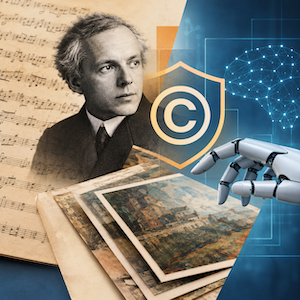
The rise of generative artificial intelligence (AI) has intensified fundamental questions at the intersection of art, new technologies, and copyright. While copyright remains indispensable for protecting works, authorship, and certain economic interests, it does not fully address the broader cultural and normative concerns raised by AI systems trained on, and operating through, vast bodies of artistic and cultural material. This article argues that contemporary copyright debates should be situated within a wider inquiry into legitimacy, responsibility, and cultural governance. Drawing on Walter Benjamin’s reflections on aura and Béla Bartók’s ethos of the pure source, it suggests that the central challenge of the AI age lies not only in protecting works, but also in safeguarding contextual meaning, communal significance, and the integrity of the relation between cultural materials and their sources. Its distinctive contribution is a source-ethics framework that connects provenance, contextual integrity, participation, traceability, and fair benefit-sharing as practical complements to copyright.


Dimensions

Altmetric

PlumX Metrics

Downloads

Downloads

Download data is not yet available.

Citations

Barz G, Cooley TJ (eds) (2008). Shadows in the field: New perspectives for fieldwork in ethnomusicology. 2nd ed. New York: Oxford University Press.
Bartók B (1976). Essays. Suchoff B (ed.). London: Faber and Faber.
Benjamin W (1969). The work of art in the age of mechanical reproduction. In: Arendt H (ed.). Illuminations. Zohn H (transl.). New York: Schocken Books, pp 217-251.
Boyle J (1996). Shamans, software, and spleens: Law and the construction of the information society. Cambridge, MA: Harvard University Press.
Bucher T (2018). If...Then: Algorithmic power and politics. New York: Oxford University Press.
Burton AG, Chun WHK, Bounegru L, et al. (2023). Algorithmic authenticity: An overview. Lüneburg: Meson Press.
Carpenter KA, Katyal SK, Riley AR (2009). In defense of property. Yale Law J 118:1022-1125.
Carroll SR, Garba I, Figueroa-Rodríguez OL, et al. (2020). The CARE principles for Indigenous data governance. Data Sci J 19:43.
Couldry N, Mejias UA (2019). The costs of connection: How data is colonizing human life and appropriating it for capitalism. Stanford: Stanford University Press.
Eliot TS (1919). Tradition and the individual talent. The Egoist 6:54-5, 72-3.
Franceschet M, Colavizza G, Smith T'Ai, et al. (2021). Crypto art: A decentralized view. Leonardo 54:402-5.
Frigyesi J (1998). Béla Bartók and turn-of-the-century Budapest. Berkeley: University of California Press.
Hafstein VT (2018). Making intangible heritage: El Cóndor Pasa and other stories from UNESCO. Bloomington: Indiana University Press.
Heidegger M (1977). The question concerning technology. In: The question concerning technology and other essays. Lovitt W (transl.). New York: Harper & Row, pp 3-35.
Kukutai T, Taylor J (eds) (2016). Indigenous data sovereignty: Toward an agenda. Canberra: ANU Press.
Kwaymullina A (2016). Research, ethics and Indigenous Peoples: An Australian Indigenous perspective on three threshold considerations for respectful engagement. AlterNative 12:437-449.
Kwaymullina A, Kwaymullina B (2010). Learning to read the signs: Law in an Indigenous reality. J Aust Stud 34:195-208. doi:10.1080/14443051003721189.
Li D (2022). Poetry bots and psychedelic Buddhas: Meet China's top NFT artist. Sixth Tone, 9 March. Available from: https://www.sixthtone.com/news/1009835
Manovich L (2001). The language of new media. Cambridge, MA: MIT Press.
Nissenbaum H (2010). Privacy in context: Technology, policy, and the integrity of social life. Stanford: Stanford University Press.
NVIDIA (2022). AI art by Ting Song: Peony Dream: Falling in Love. Available from: https://www.nvidia.com/en-us/research/ai-art-gallery/artists/ting-song/
Peru Info (2020). "El Cóndor Pasa" is recognized by the BBC as "an unforgettable song." Available from: https://peru.info/en-us/talent/blogperu/6/25/-el-condor-pasa--is-recognized-by-the-bbc-as--an-unforgettable-song-
Stiegler B (1998). Technics and time, 1: The fault of Epimetheus. Beardsworth R, Collins G (transl.). Stanford: Stanford University Press.
Turkle S (2011). Alone together: Why we expect more from technology and less from each other. New York: Basic Books.
UNESCO (2003). Convention for the safeguarding of the intangible cultural heritage. Paris: UNESCO.
United Nations (2007). United Nations declaration on the rights of Indigenous Peoples. New York: United Nations.
Whitaker A (2019). Art and blockchain: A primer, history, and taxonomy of blockchain use cases in the arts. Artivate 8:21-46. doi:10.34053/artivate.8.2.2.
Whitaker A, Burnett Abrams N (2023). Art and NFTs: The essential primer (also catalogued as The story of NFTs: Artists, technology, and democracy). New York: Rizzoli International Publications, published in association with MCA Denver.
WIPO (2023). Documentation of traditional knowledge and traditional cultural expressions. Geneva: World Intellectual Property Organization. Available from: https://www.wipo.int/edocs/pubdocs/en/wipo-pub-rn2023-5-9-en-documentation-of-traditional-knowledge-and-traditional-cultural-expressions.pdf

How to Cite

1.
Soós G. Protected works, unprotected meaning? Art, AI, and the limits of copyright: Bartók’s source ethics in the age of AI. Proceed Eur Acad Sci Arts [Internet]. 2026 Sep. 21 [cited 2026 Sep. 22];5. Available from: https://www.peasa.eu/site/article/view/83